Postgraduate Certificate in Precision Aquaculture Remote Sensing Techniques

-- viewing now

The Postgraduate Certificate in Precision Aquaculture Remote Sensing Techniques is a cutting-edge course that equips learners with essential skills for career advancement in the rapidly growing field of aquaculture. This certificate program emphasizes the importance of remote sensing technologies in optimizing aquaculture practices, promoting sustainable growth, and addressing environmental concerns.

5.0
Based on 3,425 reviews

3,171+

Students enrolled

GBP £ 149

GBP £ 215

Save 44% with our special offer

Start Now

About this course

With the global demand for seafood projected to double by 2050, there is a rising need for skilled professionals who can leverage advanced technologies to enhance aquaculture productivity and sustainability. This course offers a unique blend of theoretical knowledge and practical skills, empowering learners to apply remote sensing techniques for precision aquaculture management. By the end of this program, learners will have gained comprehensive knowledge of satellite-based monitoring, Geographic Information Systems (GIS), and data analysis tools. They will be able to use these skills to make informed decisions, improve aquaculture operations, and contribute to the industry's long-term success and environmental stewardship.

100% online

Learn from anywhere

Shareable certificate

Add to your LinkedIn profile

2 months to complete

at 2-3 hours a week

Start anytime

No waiting period

Course details


• Remote Sensing Technologies in Aquaculture
• Satellite Imagery and Image Processing Techniques
• Geographic Information Systems (GIS) for Precision Aquaculture
• Underwater Sensing and Monitoring Systems
• Data Analysis and Statistical Methods for Precision Aquaculture
• Machine Learning and Artificial Intelligence in Remote Sensing
• Advanced Image Interpretation for Aquaculture Applications
• Sustainable Aquaculture Practices and Remote Sensing
• Aquaculture Resource Management and Planning with Remote Sensing
• Case Studies: Remote Sensing Applications in Precision Aquaculture

Career path

Aquaculture engineers play a crucial role in designing, constructing, and maintaining aquatic recirculation systems, remote sensing devices, and other technology-driven solutions. They need a solid understanding of aquatic life, water chemistry, and engineering principles. Their demand is high due to the increasing need for sustainable food production. Data analysts are essential in making sense of large datasets used in precision aquaculture, enabling the optimization of farming practices. They require skills in data management, statistics, and machine learning algorithms. The growing importance of data-driven decision-making in the agriculture sector drives the demand for data analysts. Remote sensing specialists utilize satellite and aerial imagery to monitor aquatic environments, optimizing farm operations while ensuring environmental sustainability. Their expertise includes interpreting and analyzing multi-spectral data, which is in high demand as precision aquaculture increasingly relies on advanced technology for monitoring and management. GIS specialists focus on managing, analyzing, and visualizing geospatial data for precision aquaculture. They create maps, perform spatial analysis, and integrate GIS data with other software tools. Their skills are essential for managing aquatic resources efficiently and ensuring sustainable growth. Aquaculture technicians work closely with engineers, specialists, and farmers to maintain and optimize aquatic systems, using cutting-edge technology and data analysis. The demand for skilled technicians is growing as precision aquaculture continues to evolve with technology.

Entry requirements

  • Basic understanding of the subject matter
  • Proficiency in English language
  • Computer and internet access
  • Basic computer skills
  • Dedication to complete the course

No prior formal qualifications required. Course designed for accessibility.

Course status

This course provides practical knowledge and skills for professional development. It is:

  • Not accredited by a recognized body
  • Not regulated by an authorized institution
  • Complementary to formal qualifications

You'll receive a certificate of completion upon successfully finishing the course.

Why people choose us for their career

Loading reviews...

Frequently Asked Questions

What makes this course unique compared to others?

How long does it take to complete the course?

What support will I receive during the course?

Is the certificate recognized internationally?

What career opportunities will this course open up?

When can I start the course?

What is the course format and learning approach?

Course fee

MOST POPULAR
Fast Track GBP £149
Complete in 1 month
Accelerated Learning Path
  • 3-4 hours per week
  • Early certificate delivery
  • Open enrollment - start anytime
Start Now
Standard Mode GBP £99
Complete in 2 months
Flexible Learning Pace
  • 2-3 hours per week
  • Regular certificate delivery
  • Open enrollment - start anytime
Start Now
What's included in both plans:
  • Full course access
  • Digital certificate
  • Course materials
All-Inclusive Pricing • No hidden fees or additional costs

Get course information

We'll send you detailed course information

Pay as a company

Request an invoice for your company to pay for this course.

Pay by Invoice

Earn a career certificate

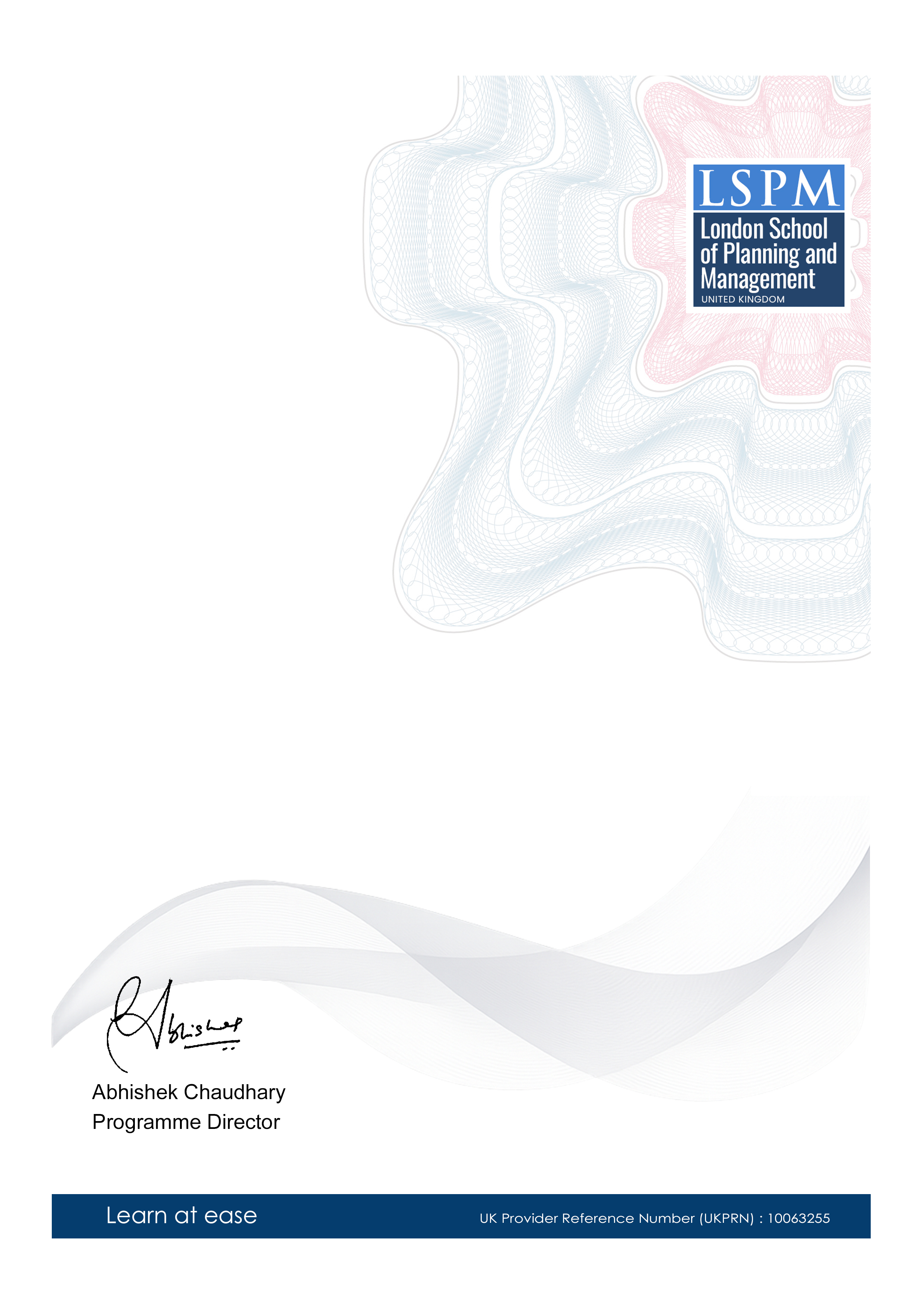
Sample Certificate Background
POSTGRADUATE CERTIFICATE IN PRECISION AQUACULTURE REMOTE SENSING TECHNIQUES
is awarded to
Learner Name
who has completed a programme at
London School of Planning and Management (LSPM)
Awarded on
05 May 2025
Blockchain Id: s-1-a-2-m-3-p-4-l-5-e
Add this credential to your LinkedIn profile, resume, or CV. Share it on social media and in your performance review.
SSB Logo

4.8
New Enrollment